Etiketter

torsdag den 23. februar 2012

We’ll Handle Google And Apple, Mr. President; You Worry About SOPA, PCFIPA, ACTA, And Big Media

We’ll Handle Google And Apple, Mr. President; You Worry About SOPA, PCFIPA, ACTA, And Big Media: hercules_capitol

Mr. President, I’m glad your administration has taken the time to craft what looks like a fairly forward-thinking and potentially globally influential policy towards consumer privacy on the internet. No doubt it will have to be snipped here and built up there and the fast pace of the technology world may make some of its provisions quaint after a few years, but overall it seems strong, and fair to both companies and their consumers.


But if you’ll forgive me for saying so, Mr. President, I think you’re barking up the wrong tree. Google, Apple, Comcast, tracking cookies, deep packet inspection — this is something we can handle with minimal assistance. Tech is a young, fast-moving field, and tends to regulate itself, perhaps because the Internet is the collective medium of billions, and tyrants don’t live long here. And to be honest, laws passed by the U.S. are considered more rough guidelines, to be transgressed at will by individuals or multinationals.


Where we do need your help, sir, is where we, the young, free Internet, have little presence and receive no consideration. The threat of bills like SOPA, PIPA, PCFIPA, and their equivalents elsewhere is real, but they are conceived and considered in that sea of ignorance and corruption that is, I am sorry to say, your current place of residence. We need your help in Washington.


I doubt you’re unaware of this, actually. Your administration has been friendly to technology and has embraced where it could have restricted and regulated. And you did, in fact, state your opposition to SOPA — though it must be said that this opposition appeared after months of criticism from practically every independent tech group in the world; our own statement of opposition, itself quite late, appeared in November. How much of the abandonment of that bill was due to real acknowledgement of the unprecedented Internet-based activism shown on January 18th, and how much was due to your administration’s opposition, announced simultaneously and rendering it politically expedient to jump ship, we will never know. But what we do know is that we could have used your support long before then.


And the result of all that effort is that SOPA is substantially back on the table, perhaps worse than ever, tied to a fail-proof bill ostensibly about combating child pornography. I don’t need to tell you how reprehensible this tactic is, or what these desperate means say about the legitimacy of the measures to be enacted.


The power of the Internet, Mr. President, which is to say the people’s power, is that of exposing something to the light — making something known. Sometimes this process amplifies something trivial, and sometimes it changes the world. But all we can do is put it out there, and in the case of legislation like this, that’s not nearly enough.


Your power, on the other hand, is to sign or veto laws in order to advance the public good. It is also to be a voice representing that public. That means expressing to a Congress full of clueless old men and bursting with lobbyist money that the U.S. should be a bastion of liberty and transparency, not a test market for shoddy laws ghost-written by dinosauric industries. SOPA was nearly passed despite the vocal protests of millions upon millions and the expert testimony of the people who literally created the Internet, among others.


What you can do for us — and when I say us, Mr. President, I mean for the entire population of the free Internet, internationally, as the U.S. is a trendsetter in this way — is establish a standard for freedom on the Internet that is fundamental enough and rigorous enough to compel both private companies and public servants to acknowledge it. I realize you’re in no position to dictate policy, but it is very important for the White House to at least signal that it has the best interests of the citizens of the Internet in mind. We have no assurance right now that that is truly the case.


The requirement of companies to respect the privacy of their users becomes hollow and cynical when the same government establishing these “rights” is actively working to undermine them. The left hand giveth, and the right hand taketh away. This is not a healthy representative government in action.


You may be aware that it is an election year, Mr. President, and I humbly suggest that the safety and privacy of this country’s citizens on the Internet (and indeed that of billions worldwide who value it for a variety of reasons, from recreation to revolution) must be an issue on which you personally, and by extension the United States, take a principled stand. This may be difficult. But you have the mixed fortune of standing over  one of the many fulcrums of history, and while this critical and global issue won’t be settled in the next year, or maybe even the next decade, we rely on you to at least take a few steps in the right direction.

Geolocation’s Potential Heats Up With Geoloqi’s Battery-Saving Tech

Geolocation’s Potential Heats Up With Geoloqi’s Battery-Saving Tech: geoloqi-dev-banner

Geoloqi, a name you may know because of the mobile app that once provided automatic Foursquare check-ins and geofenced reminders, is today launching its next-generation location platform as an SDK. Although previously available in API format for developers’ use, the new iOS and Android SDK makes it even easier for developers to drop in location services into their apps, whether those are consumer-facing apps, apps for government, carriers, or the enterprise.


The company was founded by Amber Case and Aaron Parecki in 2010 and (awesomely) bootstrapped with hackathon winnings until last June when it received $350,000 in angel backing. But even when one of the co-founders is known as a “cyborg anthropologist,” what makes Geoloqi really interesting is the way it handles location services. That is to say, it handles location intelligently.


One of the primary problems with location-tracking apps today is that they have a tendency to drain smartphones’ batteries by always running the GPS in the background, or constantly pinging cell towers. With the Geloqi SDK, however, Case explains that algorithms know when to turn the GPS on and off. For example, if an app is using geofences, it knows that the GPS doesn’t have to constantly be running unless you’re near those geofences, she says. (For the uninitiated, geofences are a new-ish, but still somewhat under-utilized technology that allows events to trigger as you’re passing by a given location. One example of a geofence could be a location-based reminder, like an alert that reminds you to buy milk when you arrive at the grocery store.)

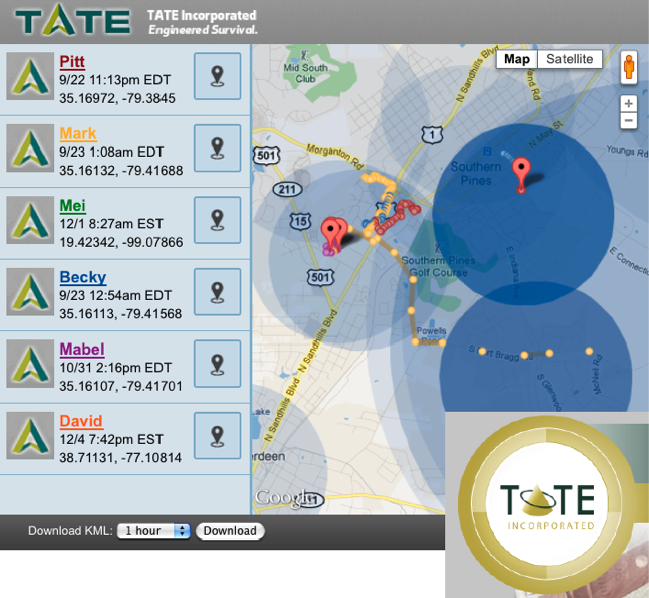
After building a sample app (the consumer-facing Geoloqi), Case says that their phone just started ringing. Enterprise, government and even carriers were interested in the technology and were inquiring about a white label version. Although the company wasn’t ready for customers, they eventually let interested parties start using a beta version of Geoloqi early last year. One such customer is TATE, Inc., a company that helps U.S. government personnel overseas, including DoD staff, contractors, and those from other agencies. With Geloqi’s carrier agnostic tech, they’re able to keep their people safe when they’re outside the U.S. using other operator networks.

In addition to real-time tracking, Geoloqi’s new SDK also provides access to location-based push messages, geofences, location-based analytics (soon), hosted spatial intelligence, plus support for iOS, Android, Windows and embedded systems.


Although the potential for Geloqi’s revenue possibilites lie with its carrier, government and enterprise relationships, such a technology will also help heat up the consumer app space, too, especially when plans start at $19/month (and testing is free).


Geoloqi is not alone in hoping to heat up this location services market, however. Other companies, like Urban Airship for example, which acquired SimpleGeo in 2011, will also help bring location-based push messaging to mobile apps.


As a potential user of such apps, watching the technology advance is exciting. To date, most of us have been hesitant to use too many GPS-enabled apps, primarily because of the battery drain issues. But if the technology can be pushed forward in a way to reduce the impact on battery life, it could become common for apps to not just remind us and alert us to things, but do so smartly.


Imagine coupon and deals apps that could tell you if you’re passing by a place that has a special available, grocery shopping apps that send you your list as you walk in the store, friend-tracking apps whose reminders can be configured by proximity, news apps hyper-targeted to your neighborhood or block, and so on.


More details on Geoloqi’s SDK, its pricing and support options are available on the company’s developer site here.


Correction: The consumer-facing mobile application no longer does automatic Foursquare check-ins, but the iTunes App Store description claimed it did, up until this article’s posting this morning. The company just sent in an update to Apple which will correct the description in the App Store.


With New Facebook Integration, Prescreen Relaunches To Make Movie Discovery More Social

With New Facebook Integration, Prescreen Relaunches To Make Movie Discovery More Social: Screen shot 2012-02-23 at 6.42.15 AM

So there you are, an independent filmmaker at a top film festival. Your movie is received well, gets some good buzz, but it’s six months before you secure distribution. You’re ready to release, but remember all those people eager to watch the movie six months ago? They’ve gone on to something else. The point is that independent filmmakers have a tough time with marketing and promotion; they don’t have the resources or tools to expand their outreach. Only the big Hollywood studios have the resources to drive enough cross-platform advertising to stir up buzz over their upcoming blockbusters, six months in advance. And, it goes without saying that this isn’t just limited to independent filmmakers, it’s true for musicians, artists, and many more.


That’s why early ThePoint/Groupon employee Shawn Bercuson, Zoosk Co-founder John Smart, Dan Rummel, Lee Wilson, and Tyler Seymour launched Prescreen last September – to bring movie lovers an easy way to discover independent films they wouldn’t otherwise and, in turn, give filmmakers, producers, and more a shot at drumming up interest in (and bringing eyeballs to) their work.


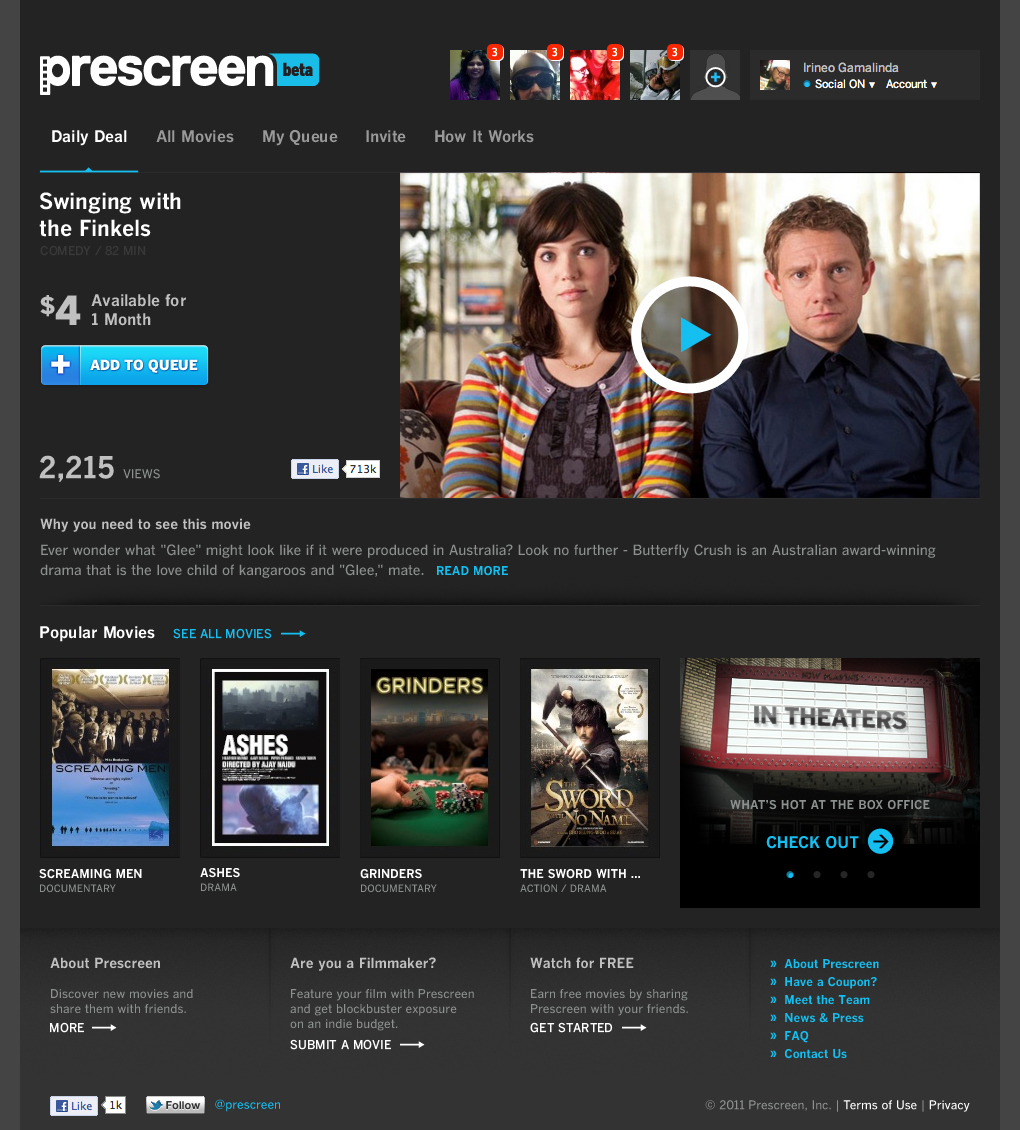
Prescreen aims to provide independent filmmakers with an alternative to traditional advertising and marketing channels with an on-demand platform that borrows a page from Groupon, serving users with daily emails that feature a particular film that it thinks will strike their fancy. Users can watch trailers of a wide range of movies for free, discovering new, curated content, and then purchase the content they want to watch, streaming it on-demand for up to 60 days.


Today, Prescreen is getting a makeover in an attempt to boost its social credentials, relaunching with a new social movie discovery experience that features Facebook Open Graph integration. While Prescreen initially targeted independent films, Bercuson tells us that the team doesn’t want to limit Prescreen content just to movies; instead, they’re going after all long-form content, and will begin to add indie-ish stand-up comedy specials, concerts, larger budget movies, and more. Prescreen aims to continue supporting indie movies, focusing on premium content – a more targeted, socially crowdsourced version of Netflix.


In the new Prescreen, users sign up for free through Facebook Connect to watch free trailers and can bookmark new content with its “add to queue” button (something with which both Netflix and users of the awesome Watch It service will be familiar with) before going on to rent on-demand.


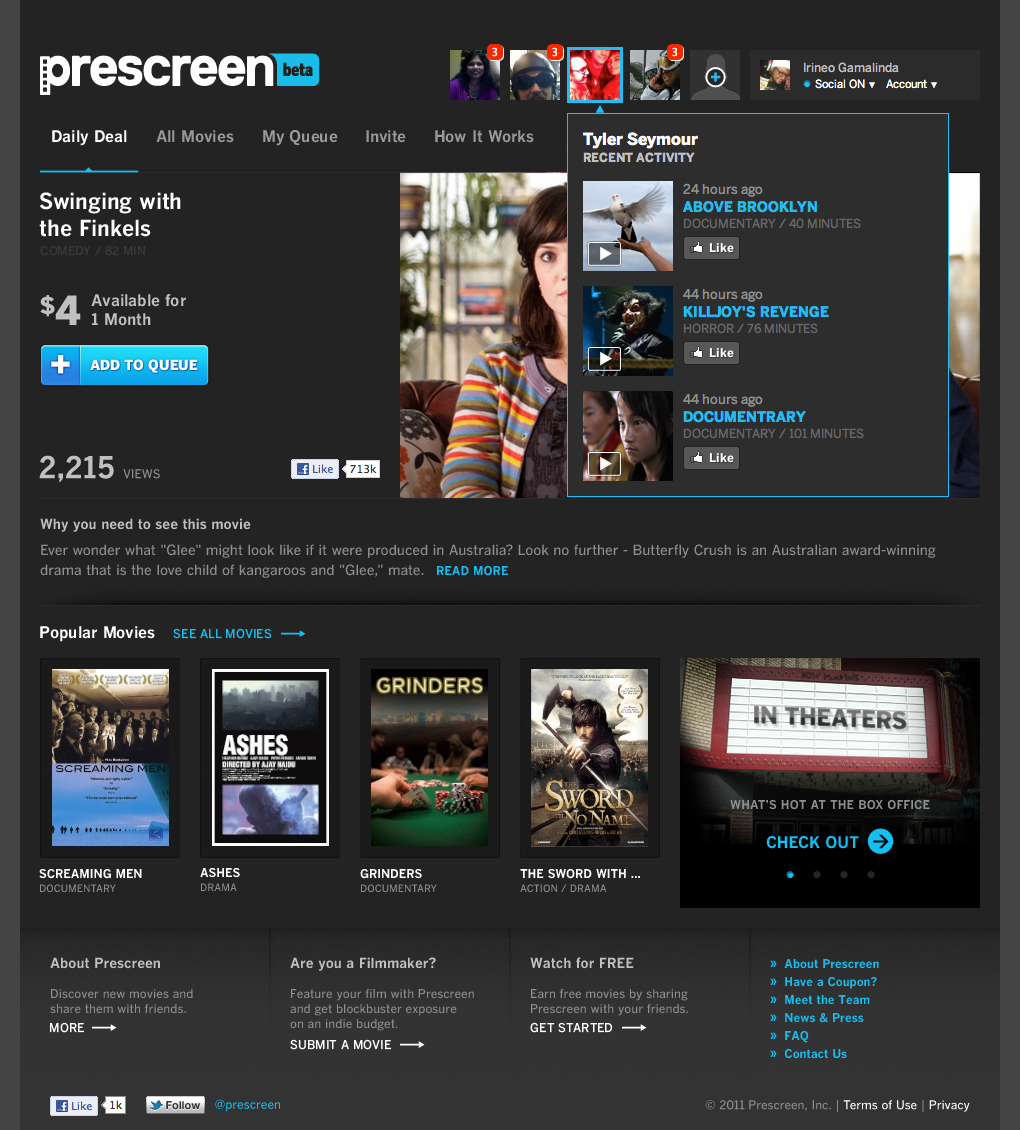
And what good would having an early Groupon employee be without offering users the chance to earn rewards and discounts by sharing movies with their friends? Prescreen continues to offer social sharing discounts, as well as daily deal-type offerings when new titles are introduced on the site. With the new Facebook integration, users can now have viewed trailers or queued movies pop up in their Facebook timeline or news feed, and, if their Facebook friends have signed up, users can also view what their friends are watching.


Again, it probably now goes without saying, but everyone’s on Facebook – even your cat – and social proof, or influence, has proven to be an effective way to discover new content, travel destinations, music, clothes, etc. that is relevant to you personally. The idea being, who knows you better than your friends? And whose recommendations do you trust more than a close friend, or loved one? A stranger?! Don’t be ridiculous! Not in the Facebook Era.


Thus, allowing users to see what their friends are watching helps them discover titles that are relevant to them, but it’s also a great, organic way for content producers to turn up the buzz on their work. Good old-fashioned word-of-mouth marketing, viral-social-graph-style.


As to monetization, beyond taking a cut of on-demand sales (the rest goes directly to the content owner), Prescreen also provides content producers with analytics and demographic info related to their content, allowing them to better target their marketing efforts. Those who offer their content exclusively to Prescreen get that stuff for free, and those who are already sharing their content on other sites pay a fee.


Prescreen’s model definitely capitalizes on a growing trend among artists, which is to bypass traditional deals with big media, (like going to HBO for a comedian), and offer their content on their own site for a price they choose. This obviously also means they don’t have to deal with profit-sharing. Prescreen could become a go-to resource for artists that want to avoid contracts, losing control of their content and so on.


The CEO also tells us that not only are they planning to build a dashboard for content producers (to view analytics, etc.), but they want to expand the role of content curation on the site by bringing in, say, a famous director, who gets to feature his or her favorite indie horror films for a week. This seems like a no-brainer, as it could be a big draw for viewers, and fun for the notables.


Obviously, the startup wants to take advantage of the multi-billion dollar industry that is entertainment marketing. Bercuson believes that by offering Facebook integration for viral sharing and by working with content producers to place ads on the site and giving them access to views, demographics, it will be able to boost conversion and get a leg-up on Hollywood, which is still stuck in those CPM models. At least that’s the hope.


By tracking views on trailers, and then comparing that to what viewers actually watch, the company will start to get a better sense of how the two correlate – how much/often intent (watching trailers) leads to making a purchase. That’s the key. They can then tweak discounts, flash deals, etc. accordingly, and marketers start to know how best to target, and when.


The startup has raised $1 million in seed financing to date, from the likes of Former Facebook VP Chamath Palihapitiya, Ed Cluss, Auren Hoffman of Rapleaf, Saad Khan of CMEA Capital, and Bercuson himself. They’re also in the process of attempting to build out their advisory board with industry veterans, and already have Blockbuster exec Tim Wesley and IM Global Founder Stewart Ford.


For more on Prescreen, check them out at home here. And let us know what you think in the comments.


Box bets on Android in business with new update, gives all users 50GB storage free

Box bets on Android in business with new update, gives all users 50GB storage free:
box-android-655

Cloud storage powerhouse Box has updated its Android app with tons of new features. And to celebrate, the company is giving away 50GB of free storage to any Android user who logs in during the next 30 days.

There has been a lot of movement in the cloud-storage space in the past six months, so Box’s effort to bulk up in mobile aren’t surprising. Apple recently announced it would directly integrate its consumer cloud solution iCloud with its upcoming Mountain Lion Mac OS. Microsoft is also on its way to making its SkyDrive product available everywhere as well as integrating it with Windows 8. Google may also enter the fray with its own Drive cloud-storage service in the next few months. And of course, you’ve got big players like Dropbox, SugarSync, and Amazon Cloud Drive that continue to innovate, too.

Box’s new Android update brings the company full speed into the present with an overhauled user interface, new features, and compatibility with Ice Cream Sandwich, the latest version of the Android OS. The company actually worked with Google to help redesign the user interface with Ice Cream Sandwich in mind, which even users who have an older version of Android will benefit from. New features include the ability to comment on files, add teammates to individual folders, and batch uploads for uploading multiple files at once.

Those concerned about Android fragmentation need not worry too much, as Box supports most older versions of Android. “What’s great is that Box is not a super intensive application,” Box VP of Platform Matthew Self told VentureBeat. “The experience is fairly consistent across all Android devices.”

Box will also be adding support for four languages — French, Italian, German, and Spanish — to the Android app, which ties to Box’s growing international presence. Self told me that 40 percent of the company’s users are now outside of the U.S. and 20 percent of the company’s revenues are generated from international markets.

On top of giving away 50GB of free storage for life for those who login from Android devices, Box will also be giving away 20 Samsung Android tablets to a single company that can compellingly explain how it plans to use Box to improve its daily routines. Two runners-up for the contest will win a Samsung Galaxy Tab.

The new Box Android app is available today in the Android Market, and will soon be available in the Amazon Appstore, Barnes & Noble Nook Store, LG World, and the Verizon Store.

A few more screenshots from the new Box Android app can be viewed here:


And you can check out a Box-created infographic that describes just how big 50GB is as well:

box-50GB-infographic


Filed under: cloud

Facebook’s ad revenue will hit $5B in 2012, but growth rates have peaked

Facebook’s ad revenue will hit $5B in 2012, but growth rates have peaked:


Facebook is set for a record-shattering initial public offering and, according to a new report, it will bring in more than $5 billion in advertising revenue this year. But Facebook’s financial future may not be as bright as the eye-popping figure would at first suggest.

2011 was a banner year for Facebook in terms of advertising revenue. The social network saw 68.2 percent growth and took home $3.1 billion in ad revenue for year. In 2012, market research firm eMarketer predicts that Facebook’s ad revenue will balloon to $5.06 billion, but the figure represents just 60 percent growth over 2011 and points to a downward spiral in growth rates.

Ad revenue growth will be nearly sliced in half by 2013 and inching closer to zero by 2014, eMarketer estimates. Facebook will make $6.72 billion from ad revenue in 2013 (32.8 percent growth over 2012) and $7.64 billion in 2014 (13.7 percent growth over 2013), the firm predicts.


The dramatic decline in growth rates means that Facebook will need to radically grow its payments business to please future shareholders and continue to post strong annual revenue gains.

In 2011, just $557 million of Facebook’s revenue came from payments, and eMarketer pegged the company’s ad business as generating 85 percent of total revenue. The payments figure is, however, up fivefold over the previous year and suggests that the alternative money-maker could eventually grow to be a big and important business for Facebook.

And while Facebook’s ad revenue growth seems to have peaked, one other thing to consider is that the company is taking an even larger chunk of the overall online ad revenue market with each passing year. Facebook will account for 6.5 percent of online ad revenue in the U.S. in 2012, according to eMarketer, and will increase its share to 7.1 percent by 2013.


Filed under: media, social, VentureBeat

Veteran Googler Dennis Woodside To Replace Sanjay Jha As Motorola Mobility CEO

Veteran Googler Dennis Woodside To Replace Sanjay Jha As Motorola Mobility CEO: dennis-woodside-630
With Google’s purchase of Motorola nearing completion, some anonymous sources close to the situation have revealed that a management shakeup is in the works too. According to a new report from Bloomberg, Motorola CEO Sanjay Jha will be replaced by veteran Googler Dennis Woodside when the deal comes to a close.

Woodside is no stranger to the Google-Motorola situation — in addition to serving as an SVP and President of Google Americas, Woodside was also chosen to lead Motorola Mobility’s integration into Google last September. Though Woodside’s selection for the spot isn’t a huge surprise considering his role in bringing the two companies together, earlier rumors indicated that Google Chief Business Officer Nikesh Arora would eventually be the one to take Motorola Mobility’s helm.

No word yet on when the shakeup will officially occur, but it’s quite the move for Motorola Mobility. Since Jha became CEO of Motorola’s Mobile Devices division in mid-2008, the company went from producing occasionally-handsome featurephones to becoming a major player in the smartphone space thanks to their timely adoption of the Android platform.

While Mr. Jha can probably see the light at the end of the tunnel, he still has some time left to enjoy his position. Though both the U.S. Department of Justice and the European Commission warily signed off on the transaction, Google still needs approval from China, Taiwan, and Israel before they the deal can be finalized.